
Vale Cru's annual showcase of hand crafted, small batch wines is on again at the Victory Hotel in the beautiful McLaren Vale wine region. Tickets are $100 per person and available through trybooking.com (Vale Cru at the Victory).
Real People: James Hook
James' interview with Graeme Goodings
Lazy Ballerina is now open Friday, Saturday, Sunday and Monday.
2016 Vintage Report
Vintage Report by James Hook
The grapes are in... What will the wines be like? Read report to know what has influenced the wines for this year.
Vintage 2016 will be remembered for a warm and dry spring, which promoted shoot growth and flowering, followed up by heavy rain immediately before harvest which helped boost vineyard yields. At harvest vines produced some of the bigger crops we have seen since 2004, but they generally weren’t overcropped as vine growth was balanced.
The reported harvest from McLaren Vale was 40,997 tonnes in 2016, 12,000 tonnes above the 2015 harvest and 21% above the five year average crush.
The warm spring and early summer days and nights ensured that vines grew well and then set well. The 2015/16 growing season had some similarities with the lean 2006/07 and 2007/08 seasons. In all three, growing season rainfall was less than 50% of the long term average.
Overall, rainfall for winter was lower than average, due to a dry June 2015, and this was followed by long dry periods where no effective rain fell until the first week of February. Disease pressure was generally low due to the long dry periods, following on from dry 2013 and 2014 springs as well. Irrigation application was vital to crop health and the local recycled water system, that supplies 45-50% of the region’s irrigation water, was stretched. Rationing of this water source was flagged in January but fortunately full allocations were maintained.
Growers were able to compensate for the shortfall in rainfall with improved irrigation techniques and an uninterrupted supply. White grape harvest started at the end of January, with sparkling base wines and vineyards destined for light white wine styles.
At the beginning of February, immediately before the bulk of the region was to be harvested, McLaren Vale had double its average monthly rainfall over two days due to one storm. However, far from having a negative effect, the intense rain event increased the bunch weight of crops at harvest and relieved any water stress on the vines. The rain also delayed the start of red grape picking into the middle of February. March had above average rainfall, but fortunately this fell after a high percentage of harvest was complete. Powdery Mildew flared up and Botrytis increased but only on the latest picked fruit.
Encouraging your children to dream big.
We are not experts in work/life balance. Far from it. Balancing work and our personal lives is difficult.

2kw
We are witnessing a generational shift in our attitudes to work. Millennials (those born after 1980) are more likely than their elders to blur the lines between work and home. Some 81% of them think they should set their own work patterns. For some, that might involve virtual meetings (by Skype, for example) rather than real ones, the opportunity to work from home when they want to and, ideally, a no-recrimination clause in their contract that would be activated when they tell their boss to shove it when she asks them to work next Sunday.
What happens To our business over the next few years will be determined by little Emmy. What does she want form her life? Right now that is having fun with her parents. Dream big.
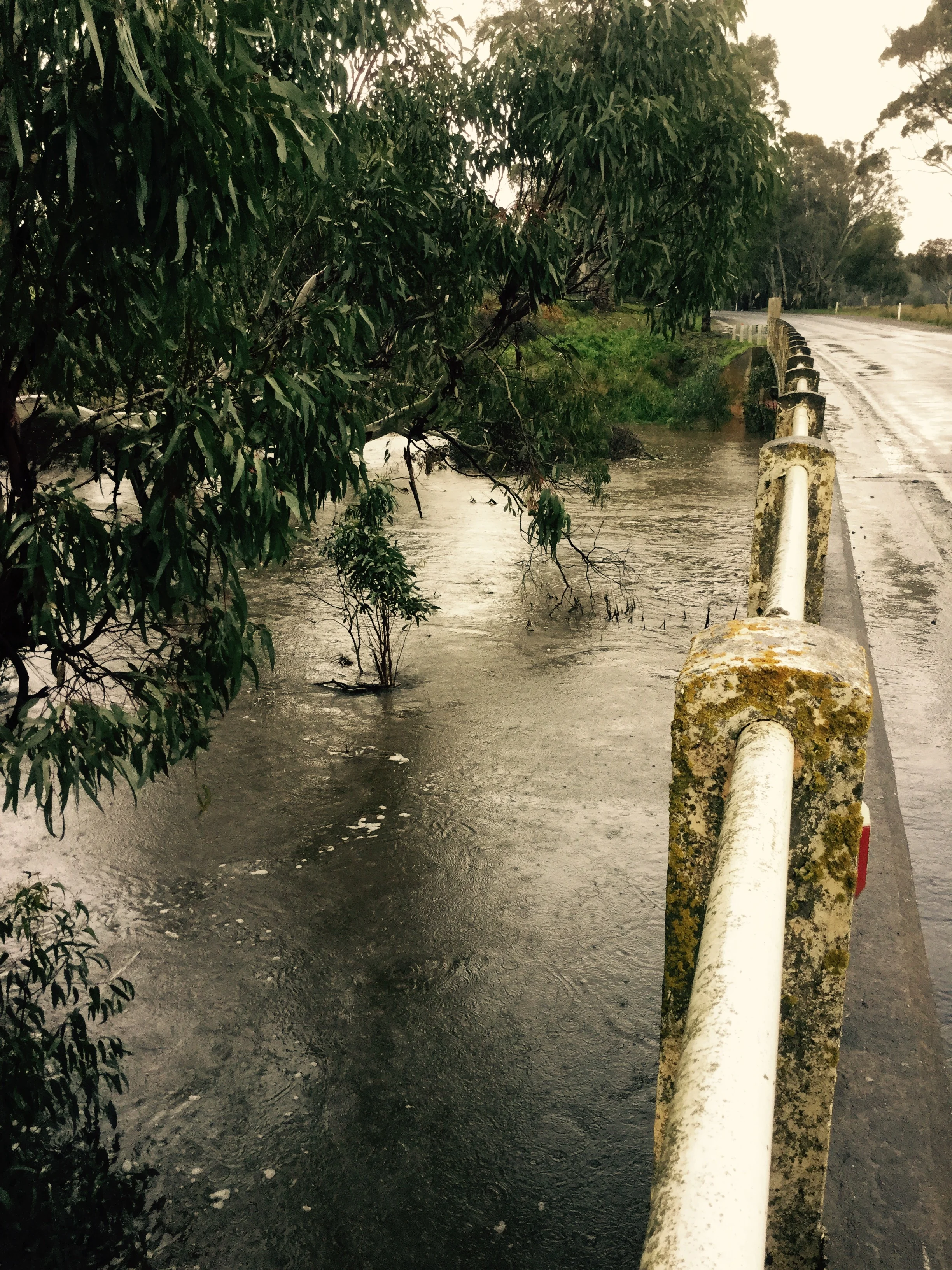
Meadows Creek in flood.
Dingabledinga, our localities name, is thought to mean place of much water in the local indigenous language.



Picking Grapes at Reynella in 1896 (c) SA Library
Reynella - The History of McLaren Vale Wine #1
Reynella. They named a town after him. He must have been pretty important in his day. Town founder.
The story of Reynella is well known, as it should be, it is the first story in what compiled becomes the history 'McLaren Vale wine'. Of course at the start it was nothing so grand. There was no marketing, no parades and no wine shows, just one man, his wife and a section of land in the Hurtle Vale.
Even early in our wine history if you were into viticulture in South Australia you owed a debt to John Reynell. He was the first settler to fence his property, on of the first settlers to plant a vineyard and the first to dig a wine cellar. Most notably, in 1850, he took on a young man named Thomas Hardy to help him to tend to the vineyards. By the 1860's he had twenty odd vintages under his belt.
Fellow McLaren Vale wine pioneers Dr Alex C. Kelly and George Manning got their inspiration from John Reynell. The three regularly traded grape cuttings, wine and ideas.
Sir James Hardy, the great grandfather of Thomas Hardy, reflected in 1984, on the day that Thomas walked down John Reynell's driveway and asked for a job. He wondered what they would have thought about the wonders of 1980's wine technology.
Sir James said,"I wonder what they would have thought about what we are doing today..."
I would answer, they would have been amazed by our technology, but we should be equally amazed that they made grape growing work without it, in a hostile land, without anything more complicated than a horse, cart and hand tools. These were flesh and blood people. Creative, bold and daring.
I think John would be amazed we remember him.
The first vintage John Reynell produced was in 1842, in a time before yeast was discovered and he built the Old Cave cellar in 1845. This was his low tech version of temperature control.
The cellar survives in part of the grounds of Accolade Wines Australia Head Office.
John Reynell was born in Bristol, England, on February 9, 1809. After his father’s death when he was only 14, Reynell left England and worked in Egypt, America, Europe and Russia. He worked to better himself.
At age 29 he emigrated to South Australia, arriving in 1838. He had a shipboard romance and married fellow-passenger, Mary Lucas, in 1839.
Reynell's tough working life had given him a strong sense of resourcefulness. He was a capable, strong minded man, and with the support of his wife, he was an ideal pioneer.

Reynell as a young man.
John Reynell's own letters claim he was the first settler to enclose his entire 80-acre (32 ha) section of settlement land. A little later he had to cut his fences to allow for the alignment of a proposed road for the passage of a regular mail run to Encounter Bay which was established by the end of 1839.
The path that the mail route took became the 'Great South Road,' now Main South Road.
In 1841, Reynell began the planting of his vineyard with cuttings he had planted the year earlier at a temporary site on the banks of the Field River.
His first vineyard was called Stony Hill and he would have planted his vines as one year old rootlings. The next year he continued planting his farm establishing vineyards on his home farm which is now the winery site across the road.
By 1854 there was a demand for land for housing in the area and in February of that year, John Reynell drew up a Notice of Sale for a portion of his Reynella Farm for the establishment of the township of Reynella.
Reynell subdivided his farm and they named the town after his wine label.
By 1866 the town had a steam flour mill, hotel, post office, general store, school and chapel. However by the end of the Nineteenth Century as many farmers had moved to the Northern agricultural lands, Reynella was said to be "a village of the past, as several ruined houses along the road remain to testify.”
John Reynell died in 1873 and is buried at Christ Church, O’Halloran Hill. His sons, Walter and Carew Reynell, took over the wine production.

A pruning demonstration in Reynella in 1923 (c) SA Library.
In the 1950s and 60s the town of Reynella became engulfed in urban expansion and has become largely a residential area. In a twist of fate, the company former Reynell employee Thomas Hardy created, Thomas Hardy and Sons, ended up purchasing the Reynella Winery in 1982.

Stony Hill Vineyard pictured in 2009 before it was subdivided into housing.
Ironically, today there a much debate today about plans to subdivide Reynell's original Stony Hill Vineyard, together with Reynella home block they have lasted into the modern age. The buildings are heritage listed, but Stony Hill has become separated.
The value of buildings can be measured, however old farming land less so. What value does the efforts of the Reynell's have? What value is the site where Thomas Hardy sweated in the summer sun, while John Reynell taught him how to weed using a horse drawn plough? On pure economics very little.
As a vineyard those original vines Reynell planted have long since gone. The Stony Hill vineyard has replaceable stock, the oldest current vines date back to 1968. The vineyard no longer has significant value as a farm. Yet it remains as a link to a pioneer who we all owe so much. At the very least it is a living link to a man to took pride in his resourcefulness.
In today's wine world the name Reynella survives as the Chateau Reynella wine range and other similarly named products from Constellation Wines Australia.
More obtusely Geoff Merrill Wines also remembers those pioneering days as his Mt Hurtle Winery. Mt Hurtle was purchased by Mostyn Owen in 1897 and named after the original name for the wider Reynella area - Hurtle Vale. Geoff Merrill was the winemaker for Chateau Reynella during the 1980's and is a living link between the pioneering winemakers and the present age.
References:
Burden, Rosemary – Wines & Wineries of the Southern Vales (Adelaide 1976)
Reynell, Lenore & Margaret Hopton – John Reynell of Reynella: A South Australian Pioneer (Adelaide 1988)
Hardy, Sir James - Age Newspaper, Oct 23 (Melbourne 1984)
White, Philip - www.drankster.blogspot.com (2009)
James is the 2016 chair of the Vale Cru
Tuesday night the Vale Cru hosted our AGM and elected our representatives for the year.
The Vale Cru works collectively. Each member helps themselves and each other in developing new skills in the making, marketing and selling wine. Each of members has different skills and specialities.
We have been working together since 2008 which makes us one of the longest collectives going around in the wine industry!
Behind the scenes I have taken over as chair for 2015/16 assisted by Scott Heidrich (Rusty Mutt) as vice chair, Sadie Gomer (Wistmosa Wines) as secretary, Maria Bottin (vigna bottin) as treasurer and Toby Bekkers (Bekkers Wines) Rose Kentish (Ulithorne Wines), Julian Forwood (Ministry of Clouds), Andrew Wood (Waywood Wines) and Paul Bottin as a committee.
We have offered membership to five new up and coming wineries which we will announce once they accept joining with us.
I am a massive believer in working collectively and sharing information, techniques and skills. I am excited to work with the Cru.
We have a series of high quality events planned kicking off with the SALA festival in August and the Victory Event in October.
The calendar will be published soon.
Regards,
James Hook
Lazy B and the Vale Cru are proud to sponsor the 2015 SALA festival.
Did you know that in our own small way we are helping with this years SALA festival? With our fellow members of the Vale Cru we have supplied a wine sponsorship to all the SALA launch events.
Look out for our wines and enjoy the art! We are proud to help in our small way.

2015 SALA LAUNCH: with Kate Moskwa, Angelique Joy and Brent Leideritz at the official launch held at the Advertiser building on July the 3rd. Image (c) SALA 2015.
SALA has exhibitions, displays and performances running all through July and August. WWW.SALAINC.COM.AU

The Great French Wine Blight - The French countryside is dotted with Phylloxera crosses. Since nothing else appeared to stop its inexorable march, some viticulteurs turned to religion in a desperate attempt to rid the vines of this plague.
The Horrible March of the Wine Aphid
History Repeats?
There is a secret risk that could destroy the most valuable asset we have. There is a pest that can destroy old vines on their own roots. By historical accident the old vineyards in McLaren Vale, the Barossa, the Clare and Eden Valleys and Coonawarra have become the great survivors of this hidden plague.
These old vines have helped these wine regions continues o produce wines that are some of the best in the world. Wine producers like Wendouree, Henschke, Teusner, Kay Brothers, Noon Wines and hundreds of grape growers are guardians of priceless old vines. These vines are now threatened.
The risk comes from a little aphid that only lives on the roots of grapevines, Phylloxera.

"THE PHYLLOXERA, A TRUE GOURMET, FINDS OUT THE BEST VINEYARDS AND ATTACHES ITSELF TO THE BEST WINES." Cartoon from Punch, September 6, 1890, by Edward Linley Sambourne (January 4, 1844–August 3, 1910).
The threat has always been with us (the Phylloxera aphid arrived in Australia circa 1877) but since it remained, against the odds, confined to the North Eastern Victoria and Nagambie areas for so long, it has dropped off many wine growers radars. Maybe it's the recent increase in plantings which has reduced the distance between vineyards, or maybe people became too casual with the protocols after getting away with living with the threat for so long but something has changed and Phylloxera has now quickly become a more immediate threat to all own rooted vineyards in Australia.
Phylloxera represents a clear and present danger to Australian vineyards now. For how serious this could be we only need to look back to history to show us how.
Phylloxera was thought to have arrived into Europe sometime around 1858, or 1860. It was introduced from North America. It can hardly be seen with the naked eye. There had been trade in grape stock between the two continents for over two hundred years previous, but no one had notice the grape aphid.
It is likely Phylloxera only became a problem in France after the invention of steamships. This new technology allowed a fast journey across the Atlantic ocean, allowing the Phylloxera to survive the trip. An increase in fast travel and between the continents made its introduction inevitable.
The french farmers initially did not know what Phylloxera was doing to there vines, they just saw the effect, a sudden vine death which they likened to consumption. In 1863 the first cases had turned up in the old region of Languedoc.
They called it wine blight. This wine blight caused the entire path of French industry to change and is estimated to have cost double the repatriations the French had to supply Prussia after their losing war of 1870.
Such was Phylloxera speed and consequence as it spread through France and the rest of Europe it was likened to the black plague.
For many this might seem like an ancient history lesson, irrelevant with the pressures of a recession and environmental concerns like droughts and fires, but the parallels between the past and present seem obvious to me.
I am scared of a repeat.
Around Australia phylloxera is clearly being mobilised. Previously confined to North Eastern Victoria Phylloxera is on the march. As mentioned Phylloxera was first detected in Australia in 1877, in Geelong, and was responsible for the near destruction of the Victorian wine industry in the 1880s. Until fairly recently it was confined to small areas in central Victoria (Nagambie, Upton, Mooroopna) and northeast Victoria (Rutherglen, King Valley), in southeast New South Wales (Corowa) and in Camden and Cumberland near Sydney. However, there have been several detections in central Victoria in the past 10 years (Buckland Valley 2003, Ovens Valley 2003, Murchison 2006, Yarra Valley 2006, Mansfield 2010).

1. RED: Phylloxera Infested Zone (PIZ) known to have phylloxera
2. GREEN: Phylloxera Exclusion Zone (PEZ) known to be free from phylloxera
3. CREAM: Phylloxera Risk Zone (PRZ) phylloxera status unknown (but never detected)
South Australia now faces the imminent arrive of the blight. While their is a slight risk an increase in travel and tourism between our wine regions seeing Phylloxera breaking out of its containment in Victoria the main risk come from the wine industry itself.
Recent changes to quarantine regulations are making it easier to transport grapevine material and machinery material from any PEZ (green zone in the map above) to any other PEZ. While this may seem well and good many of the Victorian PEZ regions have only recently been declared Phylloxera free. This has been the result of survey work conducted by the Victoria Department of Primary Industry (DPI).
For whose benefit is this change? Why the need to bring grapes and machinery direct from interstate, from regions which sit right alongside known Phylloxera Infested Zones (Red zones), into the heart of SA?
I have heard it suggested that large winegrowing companies will benefit moving grapes and machinery around the country, by making small savings in convenience, cost & paperwork. Victorian harvester companies moving machinery into SA will also benefit. The Victorian DPI will justify the millions of dollars spent on Phylloxera surveys. Australian Vine Improvement Association assists its nursery interests in selling material freely.
It is not popular for me to say this, but I agree.
If phylloxera arrives from Victoria in my lifetime, I want to say that I did everything I could to highlight the risk of changing the rules to place SA at greater risk.
I fear that as financial pressure is put on wine business corners are being cut. Vineyard hygiene is being cut back. Bio-security is a long term concern. This short term financial distraction could let a long term destruction slip through into South Australia.
An introduction of the aphid would cause a modern upset that would could rival the original for economic catastrophe. The original outbreak saw 40% of french vineyards devastated over a 15 year period, from the late 1850s to the mid 1870s. The French economy was badly hit by the blight; many businesses were lost, and wages in the wine industry were cut to less than half. Farmers were ruined.
Waves of immigrants moved to California and Algiers to start farming anew.
Remember that the rapid spread of the pest was in an era where the only fast travel between wine regions was by train, or river barge. It is notable that the spread of Phylloxera initially followed the main river valley of the Rhone from Languedoc to the centre of France.
Ironically in Tuscany the railways were blamed for the scourge. They called the railway a devils tool and thought it unnatural because it laid long tracks of iron into the soil. The Tuscan grape growers ripped up several miles of track in fear.
After a start in the Rhone Valley, the disease spread across the French Alps and across the Pyrenees. Bordeaux was also breached and by 1884 over a million hectares of French vineyards were dead or dying. As the plague spread, church bells were rung in alarm, anti-pest syndicates were formed, and a burn-or-perish approach was regretfully adopted.
It was not until 1868 that the French biologist Jules- Emile Planchon and two colleagues, chanced upon a group of Phylloxera sucking from the roots of a plant that a theory on the blight's cause by the Phylloxera was formed.
Once the cause of the problem was discovered, there was no apparent solution. A large cash prize was offered for a cure and many off-the-wall ideas were tested, but the prize was never awarded.
Removing and burning infested vines was only marginally effective in slowing the spread.
The to keep the wine industry only option was suggested by two french wine growers, Leo Laliman and Gaston Bazille, who both felt if European vines could be combined, by means of grafting, with the Phylloxera-resistant American vines, then the problem might be solved.
The process was colloquially termed "reconstitution" by French wine growers.

If Phylloxera came to McLaren Vale today, this remains the only solution. Our vineyards would have to be pulled up and replanted as grafted vines. Classic vineyards like Hill of Grace in the Eden Valley would have to be reconstituted because they will die from Phylloxera eating the vines roots.
A more recent lesson in the destructive abilities of Phylloxera is occurring now. Attempts in the 1960s by the viticulturists of the University of California to replace older rootstocks with the ominously named AxR1 rootstock. AxR1 performed wonderfully for a while, but a new strain of Phylloxera overcame its resistance. California experienced its own rapid outbreak, only now satellite and DNA technology was available to track the spread of infection, and Californian vineyards are now in the process of replanting at an estimated cost of between half a billion and a billion dollars.
While we do have the advantage, in modern times, in that we now know what causes the death of vines and how Phylloxera can be detected, you cannot put the gene back in the bottle. South Australia's hundred year old vineyards could be chewed up like their European forebears.
It would be introduced accidentally by a tourists boot or more likely a dirty tractor tire. It would take a few years to be noticed. We might have an advanced technology like satellite imagery to track its , but we would stand little better chance than out 19th Century compatriots of stopping a huge economic upheaval to an already stressed industry.
Like the steamships of old, the trucks on the highways could also bring with them a pest that can't be shaken - a ruinous aphid to claim the oldest remaining vines in the world.
2015 Vintage Report
Vintage report by James Hook
The reported harvest from McLaren Vale was 28,434 tonnes in 2015, 14% below the 2014 harvest. Over the past five years, the average crush was 34,806 tonnes implying that 2015 yields were down on average. This year’s vintage was the smallest in the past five years.
In general the 2014/2015 season was notable for month long periods where no rain fell. The McLaren Vale Wine Region experienced an average winter rainfall, although it fell in a strange pattern. June and July were wetter than average, but no significant rain fell during August. Temperatures in late August were notably cold overnight, which delayed budburst (EL-4) in general.
It continued to be very dry across our district through September, October and November with the lowest spring rainfall in the last 20 years. This led to very low fungal disease pressure, but also reduced the natural vigour of the grapevines and canopies grew to a smaller size than typical.

Flowering began early. The weather was warm and the winds were mild. Berry set was not affected by the weather but it was reduced by the widespread presence of Eutypa lata, which has become the most economically damaging disease in the region.
December passed with rainfall continuing to be low. Several locations recorded their lowest total December rainfall for at least 20 years. Despite hot days through the first week of January, cooler than normal conditions from the second week onwards resulted in the coolest January days experienced across the state since 1992. Nights were generally near average.
February began with mild weather but hot weather coincided with the start of harvest, and temperatures throughout much of February were above average. In particular daytime temperatures were 2 to 3 °C warmer than average. Harvesting for the 2015 vintage was completed earlier than expected. Picking was extremely compressed and took just over seven weeks to complete.
Yields for 2015 were generally average at best with most vineyards below average. Lower yields and warm weather did cause a spike in sugar levels in berries. The notion of hanging fruit out in the vineyard to develop flavour and seed ripeness was replaced by the urgent need to pick fruit before sugar levels got too high and berry skins began to break down.
Reports so far are indicating strong regional characters reds with early harvested Shiraz again standing out, joined by the varieties that traditionally fare well in dry seasons, Mouvedre and Grenache, along with those recently planted for drought tolerance, Fiano, Montepulciano and Tempranillo.
2014 Vintage Report
Vintage Report by James Hook
The harvest from McLaren Vale region was 33,092 tonnes in 2014, down by 2,137 tonnes (6%) from the 2013 harvest of 35,229 tonnes.

Spring vine growth.
For McLaren Vale summer conditions were significantly warmer than average with two heat waves through January and one in February tested the limits of grapevine tolerance to extreme heat. Equally damaging were extremely high speed winds which reduced berry set, stripped leaves and reduced the size of canopies and increased the level of fruit exposure. This was followed by some very hot days.
The 2013 vintage was completed earlier than expected in McLaren Vale and many thought that going into this year’s would have been the same after vines ‘shut down’ through January and February to limit water stress. The opposite happened. Rain in February rehydrated vines and freshened up vine leaves. The rain also signaled the beginning of a pattern of cooler daytime temperatures which allowed fruit to finish ripening during some relatively moderate temperatures. The moisture boost also fortunately helped improve fruit balance and crop levels for the district. This year’s harvest was prolonged by a slow ripening period. The first harvest began with sparkling base at the end of January and ended during April with the last of the red grapes crushed. Ultimately the weather though March and April produced one of the easiest vintages since the early 2000’s.
James Hook McLaren Vale Crop Watch Editor